
Magpies, Bees and Apes
Gathering, transforming, and copying - and what they mean for writing in the age of AI

Recently, I’ve been working with some young students, 8 and 9 year olds, and we’ve been looking at Romeo and Juliet. I enjoy reading Shakespeare with this age, and, untainted as they are by the need to find endless, out-of-context quotations or learn meaningless ‘lists of themes’, they seem to enjoy it too. This week I told them, as I usually do, that Shakespeare wasn’t the first to write Romeo and Juliet and that there were at least four earlier versions of the play and they reacted, as they usually do, with a mixture of horror and incredulity.
“Isn’t that cheating?” “How come everyone says he’s the greatest writer if he just copied?” One girl asked if the other writers minded, which I thought was a particularly empathetic perspective to take.
Of course, they’re good questions. And they’re remarkably similar to the questions a group of teachers asked me last week when I was discussing the possibility, or otherwise, of setting writing tasks for homework in the age of AI. Well, not the last one - no-one cares if Claude feels violated - but the first two.
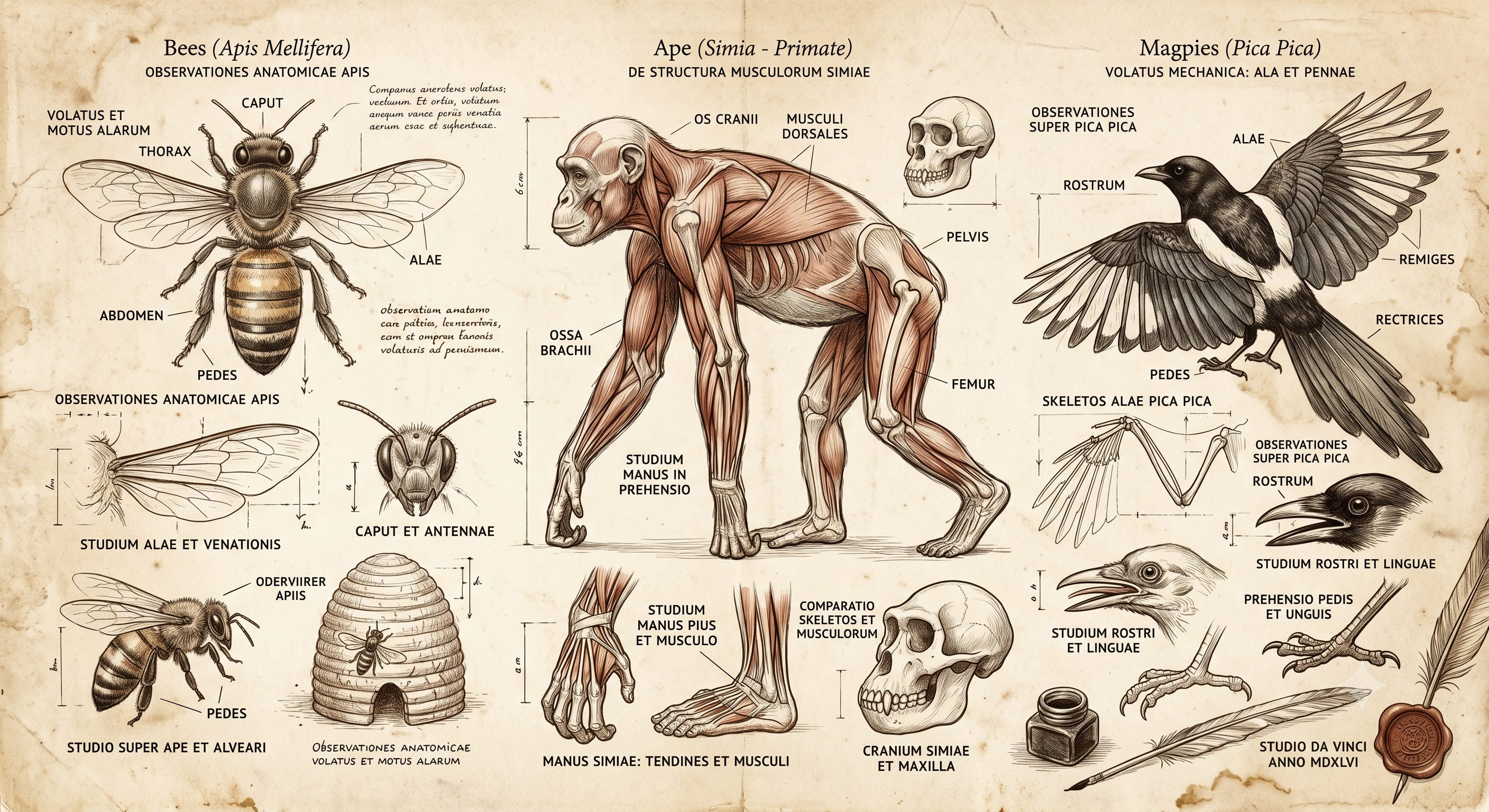
I usually tell the children that in Shakespeare’s time people were quite used to the idea of borrowing ideas from other people and then turning them into something different. It’s what Simon McBurney, the founder of Theatre of Complicite, calls the ‘magpie quality’ of theatre and, for him too, it is a thing to be celebrated. Indeed imitatio, the model of writing and education formulated by Cicero and Quintilian was dominant throughout the classical and Renaissance periods and Seneca’s metaphor of the bee, gathering from many flowers and transforming what it collects into honey, was well-known in Elizabethan England.
The humanists built an entire pedagogical framework around the idea and Erasmus’ 1512 work, De Copia, partly written for use at St Paul’s school in London, codified the practice of variation and abundance. Famously, he demonstrated how a single phrase ‘Your letter gave me great pleasure’ could be rendered in 150 different forms, though he did it in Latin, of course - Tuae literae me magnopere delectarunt. This wasn’t just Erasmus showing off, however ostentatious the use of Latin might seem to us. Rather, he was demonstrating that every sentence is but one choice among copious possibilities and the educated writer had to command those many options.
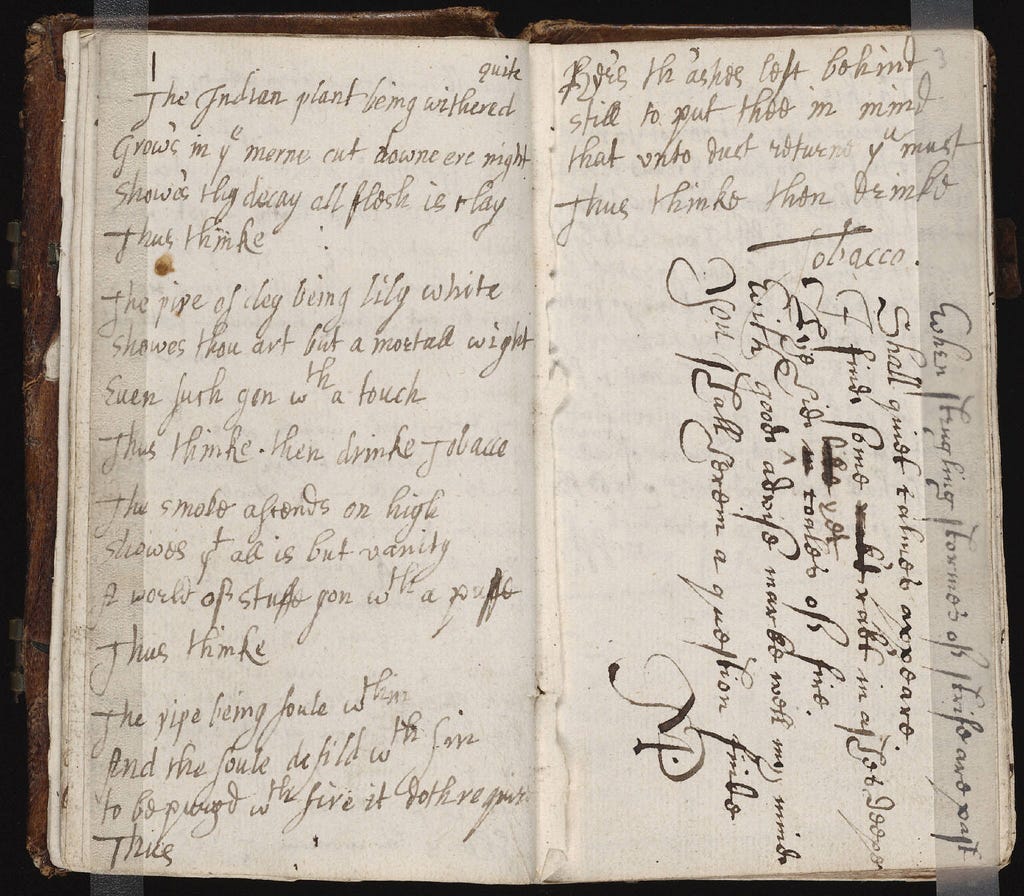
Commonplace books, collections of passages and quotations from great writers, were fundamental to the educational method and Shakespeare, at his grammar school in Stratford, would have spent years working with them, copying, paraphrasing, imitating and transforming the words of earlier writers. Never known for his brevity, this training is clearly evident in Shakespeare’s work with its verbal density, his habit of turning a thought through multiple formulations and his untroubled borrowing from his sources. It’s part of his greatness, even if it does diminish the chance of a post-show pint for the actors.
Things really changed in 1710 with the Statute of Anne, the first modern copyright law which vested rights in authors rather than printers for the first time. It implied that a text belonged to its creator in a way that had no real precedent. The law derived from John Locke’s labour theory of property where you own what you make precisely because your labour, and therefore your self, have been fundamental to the creation. This philosophical scaffolding turned the text into an extension of the person.
In the second half of the eighteenth century, this attitudinal shift gathered pace with the Romantics and their fascination with the notion of individual genius. In classical usage, genius was external and provided by a spirit or muse. It was something you had rather than something you were. With the Romantics it became internalised as a quality of mind, a native endowment that produced original work spontaneously and organically.
In his Conjectures on Original Composition (1759), Edward Young explicitly attacked the idea of imitation, calling it a theft. He said:
The mind of a man of Genius is a fertile and pleasant field, pleasant as Elysium, and fertile as Tempe; it enjoys a perpetual Spring. Of that Spring, Originals are the fairest Flowers: Imitations are of quicker growth, but fainter bloom.
And on the location of genius:
If there is a famine of Invention in the land, like Joseph’s brethren, we must travel far for food; we must visit the remote, and rich, Antients; but an inventive Genius may safely stay at home; that, like the Widow’s cruse, is divinely replenished from within; and affords us a miraculous delight.
It’s not hard to see how you get from there to Werther, Childe Harold, Victor Frankenstein or Heathcliff. The idea of genius as something natural and innate was reinforced by the organic imagery we see in so much Romantic poetry and it has become firmly entrenched in the language we all use. When a football pundit suggests ‘that turn from Messi was genius, you can’t teach that’ they are buying into a Romantic sensibility, a fact of which I’m sure Wayne Rooney is very well aware.
And, just as the philosophy supporting imitatio had been embedded in the education system, so the Romantic notion of individual genius became institutionalised. Through the 1760s, the practice at Cambridge University shifted from public oral disputation to private written examination. By 1792, William Farish introduced numerical grading, the quantification of individual intellectual output, and this led to the Cambridge Mathematical Tripos which became the foundation for just about every university exam in the world. This trickled down into the school system as part of the school reforms of the 1850s and, from there, the Romantic assumption that writing was the transparent expression of an individual mind ceased to be merely an aesthetic ideology; it became the premise for an entire assessment system.
The solo timed essay, the closed examination, the single-authored submission were not neutral administrative decisions but instruments calibrated to measure Romantic notions of individuality and the intellect.
Obviously, we didn’t go into all this in my Shakespeare class; they’d just discovered that Juliet was only thirteen and getting married and that was causing some agitation.
But this framework does explain the moral language we tend to reach for as teachers, words like cheating, dishonesty and inauthenticity. These are not just rule-infringements. They carry ethical weight within the Romantic model because we expect to see personal expression and, when that is absent, it feels like a form of deception. This is perhaps why we feel so affronted when a student hands in a piece of work we know has been largely generated by AI.
I have to say, I didn’t discuss all this with the teachers either - rightly, they were more concerned with the homework that was coming in by the end of the week - but I do think this historical perspective gives us an insight into the ways writers of the past might have viewed AI and they way we might come to view it in the future.
It suggests that authorship is not a fixed category but a historically produced relationship between writers, tools, audiences and educational institutions. It looked one way in ancient Rome, a slightly different way in Elizabethan England, radically different in the Romantic period and it’s starting to look different again in the age of AI.
As we saw last week, Wittgenstein highlighted the difficulty of seeing a cognitive framework as anything other than ‘natural’ when you are standing inside it. It takes something dramatic, like the invention of the telescope, or AI, to shift our perspective.
It’s very hard to know what sort of framework will emerge to convey our understanding of what we might call ‘human - AI collaborative writing’. To be honest, we haven’t even settled on a term for it yet - I’ve seen hybrid writing, AI-assisted writing and AI collaboration in use - and we certainly don’t have a definition, although I sense we are fairly clear on what it is not.
We don’t mean the kind of AI use that merely offloads the writing or simply passes off AI generated text as one’s own. Erasmus distinguished between imitatio and mindless plagiarism saying in The Ciceronian:
I want you to be a follower of Cicero, not an ape; I want you to digest what you read, so that it turns into your own expression, not just something borrowed from his vocabulary.
I’d say Cicero’s apes equate fairly closely here to students who simply hit the easy button and ask ChatGPT to complete the task for them.
I think a plausible definition might include an element of intentionality where the writer brings a prior purpose or argument or sensibility to the interaction. That writer isn’t asking AI what to think; they are using AI to think better about something they already have in mind.
I think it should also have a sense of evaluation where the writer assesses the AI output rather than merely accepting it. They select, reject, reshape and interrogate.
Finally, there should be a sense of transformation. The final output should bear the writer’s mark. The AI contribution should have been absorbed and altered sufficiently so that the finished piece represents a genuine synthesis.
On the face of it, that does feel rather closer to the imitatio mode of drawing explicitly on external sources than it does to the Romantic notion of creation coming from within. In both imitatio and AI-collaborative writing, the boundary between the self and the source is somewhat permeable and the relevant skill is what you do with the available material. It’s about selection and transformation. The sources are a repertoire to draw on, not a contamination to be avoided.
The training Shakespeare gathered from endless exercises working with the commonplace book to transform earlier texts into copious new forms feels quite similar to the student who is taught to use AI strategically and who prompts, selects, rejects, re-shapes the output to integrate it into their own argument. In both cases, the external resource generates language and the writer exercises judgement over it. That judgement is the education.
There is also a parallel in terms of absorption. Erasmus’ ideal was that good imitation eventually becomes indistinguishable from one’s own voice. We can detect the many sources in Shakespeare but the voice is unmistakably his. A student who incorporates AI strategically and critically into their working practices will develop their own voice through that engagement, not despite it.
Of course, there are differences too. In classical imitatio, the student worked with recognised texts that were known and which existed in an inert form. Using AI, the sources are generated on demand from the student’s prompts; the dynamic is slightly different. There is potentially another difference in terms of the effort required. Shakespeare’s own imagery makes it clear he associated school with a good deal of drudgery and hard work.
Love goes toward love as schoolboys from their books;
But love from love, toward school with heavy looks.
(Romeo and Juliet 2.2.156-7)
With so much of the narrative around AI focussing on efficiency and reducing workload it would be easy to try to remove the friction, the desirable difficulty that lies at the heart of learning. That is something we must guard against.
I am neither predicting nor advocating for a swing back from a Romantic mode of thinking towards imitatio. Both frameworks were of their times and based on philosophies, technologies and sensibilities that were then current and modern. And both frameworks became deeply embedded in their respective educational systems.
In time, we will develop a framework that feels ‘natural’ to us. We need to be purposeful and intentional in creating one that accepts the reality of AI and doesn’t pretend it can be ignored. It might start with understanding that AI use in school can feel transgressive not because it violates some timeless principle of authentic writing but because it violates a historically specific and relatively recent set of assumptions.
Otherwise, our students will be a large number of Cicero’s apes with a load of keyboards. They might eventually generate the complete works of Shakespeare but what’s the point? He’s already done that.
Connect With Me
Beyond my writing and tutoring, I work directly with schools, educators, and organisations navigating AI integration. Take a look at my website and please get in touch - I’d love to hear what you’re working on.
This really made me think about the craft of writing. It reminded me of a teaching methodology that I've heard about in creative writing -- intentionally mimicing the voice of others to understand how it is achieved. I've also thought that was brilliant advice but you helped me see why. Thanks!