
One Small Step
Active task design in the age of AI

Over the last couple of weeks I’ve been thinking about the story of the Lotus-Eaters and what we might learn from it as teachers in the age of AI. Odysseus’ response to the realisation that his men were lazing about and had forgotten everything was to drag them, very much against their will, back to the boat and strap them to their oars. It represented an immediate and pragmatic necessity - but it wasn’t a strategy designed to get the best out of his men.
There are moments in the educational cycle when we feel we are doing the same. The run-up to exams is one such point. The ‘extra revision session’ best captures the sense of desperation on both sides and, as in Homer’s epic, there’s a pretty good chance one or more of us will end up in tears.
“When you ask, ‘What happens to Macbeth in the end?’ do you think that’s something you might want to get straight before tomorrow’s literature paper?”
Of course, teachers who put on such emergency revision sessions are generous and well-intentioned. We all want our students to do well and, like it or not, the exam is currently the universal measure of doing well.
But it’s not a strategy.
If education is merely about briefly acquiring a body of knowledge and reproducing it on an exam paper, then we are preparing our students for obsolescence. We are training them for a competition they have already lost to artificial intelligence.
To survive and thrive in an AI-saturated world, they need the capacity for critical analysis and creative synthesis that only comes from a much more active relationship with knowledge. Last week, I left you with Alfred North Whitehead’s line:
Ideas won’t keep. Something must be done about them.
I’ve written before about his conception of the learning process as a three-stage rhythm, cycling through Romance, Precision and Generalisation. He defined the stage of Romance as:
the stage of first apprehension. The subject-matter has the vividness of novelty; it holds within itself unexplored connections with possibilities half-disclosed by glimpses and half-concealed by the wealth of material. In this stage knowledge is not dominated by systematic procedure.
‘Not dominated by systematic procedure’ is the key part of this for me. Whitehead was clear that there is a time when ‘systematic procedure’ is important but that it shouldn’t be the primary or the sole mode. Such teaching, he felt, led inevitably to the kind of ‘inert’ knowledge that is the enemy of Active Intelligence - the AI our students really need in the classroom.
For teachers, good task design is possibly the most effective lever we have at our disposal. Now that the exams are almost over and we are metaphorically back on the boat, sailing to Ithaca, it’s a good time to assess some of the tasks we have in our schemes of work and perhaps to think about them in terms of Whitehead’s rhythm.
As a rule of thumb, ask yourself: Could AI complete this task without any prior thinking from the student?
Even better, stick the task into Gemini and see what you get out.
If AI instantly produces something equivalent to what a student might only produce with significant effort, you might ask if the task is actually achieving its intended effect.
I’m very aware that I tend to take my examples from literature and related fields so, this week, I want to try to apply these principles to a different sort of discipline.
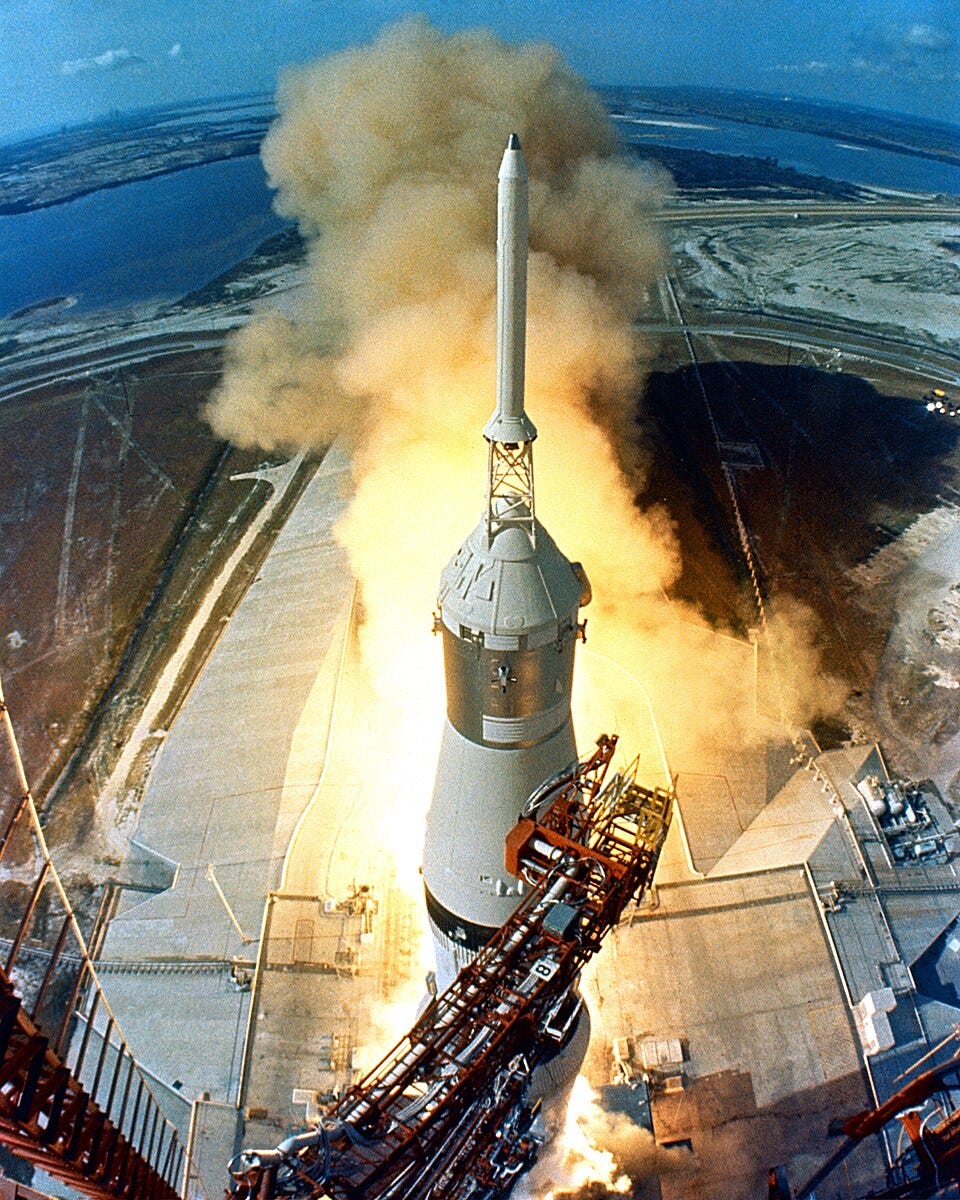
My wife wasn’t interested in science at school but when, as an adult, she watched documentaries commemorating the Apollo moon missions, she was completely captured by the romance and wished she had been taught about them in class. She’s written really well about it here and, yes, we still have the jumpsuits (her, not me) and the tea towel (shared). I’m sure she’d once have been taught that F=ma but she has no recollection of it now, a state that probably began seconds after she handed in the inevitable worksheet and moved on.
Aside from the general point about stories being important in all teaching, whatever the discipline, it’s an illustration of romance as a pre-requisite for the precision phase and, indeed, for the kind of enduring learning we all want to encourage in our students.
So, the moon landings. How can we use them to contextualise the romance of physics?
I did manage to find an Apollo-related question in an old GCSE textbook:
The Saturn V rocket had a total mass at launch of approximately 2.97 × 10⁶ kg and produced a total thrust of 3.4 × 10⁷ N. Calculate:
(a) the weight of the Saturn V at launch (use g = 9.8 N/kg)
(b) the resultant upward force on the rocket at the moment of launch
(c) the initial acceleration of the rocket
(d) explain why the rocket’s acceleration increased as it climbed.
I don’t have a clue what the answers are - but Gemini did. And produced them in a few seconds. Claude agreed and so I’m going to accept them. Accept them, but not understand them.
This strikes me as a perfect example of an ‘inert’ task. The student doesn’t need any knowledge or understanding before pressing the ChatGPT Easy Button. It’s highly likely they won’t have any knowledge or understanding afterwards either.
So, how can we re-frame the task to make it more active and, crucially, how can we use AI to augment the task, to enable us to do things we couldn’t achieve without it?
Here’s my suggestion. And, when I say ‘my’ suggestion, I ought to acknowledge some help from my ‘friend’ Claude.
The Saturn V was the largest rocket ever built. Its initial acceleration off the launch pad was approximately 1.6 m/s².
Part 1
Before you do any calculations, write a short prediction. The astronauts have described the first few seconds of launch as feeling slow — almost gentle. Some have said it felt like the rocket was barely moving. Why might this be? Use what you know about acceleration and forces to suggest at least one reason. You’re not expected to get this right — but commit to a position before you go any further.
Part 2
Now calculate, using the data below:
Saturn V mass at launch: 2.97 × 10⁶ kg
Saturn V thrust at launch: 3.4 × 10⁷ N
Saturn V mass after first stage burnout (about 2 minutes 40 seconds later): 7.5 × 10⁵ kg
Saturn V thrust at first stage burnout (approximately the same): 3.4 × 10⁷ N
(a) Calculate the initial acceleration of the Saturn V
(b) Calculate the acceleration at first stage burnout
(c) Calculate the acceleration a Formula 1 car can produce (0 to 100 km/h in about 2.4 seconds)
Part 3
Now open an AI tool and ask the following question,: “I am studying GCSE physics. I have calculated that the Saturn V’s initial acceleration was about [add your answer], its acceleration at first stage burnout was about [add your answer], and a Formula 1 car accelerates at about [add your answer]. The Saturn V is the most powerful machine ever built — but it had a smaller initial acceleration than a Formula 1 car. The astronauts said launch felt slow. Was this because the rocket was actually slow, or for some other reason? Explain at GCSE level. Please also check the accuracy of my answers.”
Part 4
Read the response. Now write a short paragraph that does two things. First, explain whether your original prediction was correct, partly correct, or wrong — and what you now understand that you didn’t before. Second, explain why, in your own words, the Saturn V — a machine more powerful than anything else ever built — could accelerate more slowly than a sports car. What does this tell you about the relationship between force, mass and acceleration?
While it focuses on essentially the same equation, this task works very differently from the first, largely because it requires the student to do some prior thinking. Crucially, the question the students have to engage with first is quite accessible; some will take a psychological approach and reason that it was down to the astronauts’ perception, others might attribute it to camera angles, others might hone in on mass as the dominant factor. The answer they reach is less important than the fact that they have engaged actively from the very beginning.
Whatever they predict, the calculation then confirms or unsettles their intuition and the AI dialogue forces them to articulate the principle.
The unique advantage of using AI in this task is that it provides feedback which is personalised to the student’s initial response and pitched at the level of their initial thought. That simply isn’t possible in a traditional classroom where a teacher or a textbook will have to work towards some notional average student.
I don’t pretend this is magic or that this task will instantly turn a class ‘on’ to physics. I do suggest that it responds to the challenge of AI by using the tech purposefully as part of an active task where the student has to bring some level of thinking with them.
If we are to teach our students how to make the most of AI, we will have to do some serious thinking about how we use the technology in our task design. I don’t mean using it ourselves in order to create traditional tasks more efficiently. I do mean re-designing those tasks that no longer work in the way they might have done once, so that our students are actively engaging with AI with intention and a clear sense of strategic advantage.
And, of course, task design is only part of the picture. Even the best-designed task can be undermined if AI enters the learning sequence at the wrong moment. But that’s for next week.
Connect With Me
Beyond my writing and tutoring, I work directly with schools, educators, and organisations navigating AI integration. Take a look at my website and please get in touch - I’d love to hear what you’re working on.