
Polishing the Floor
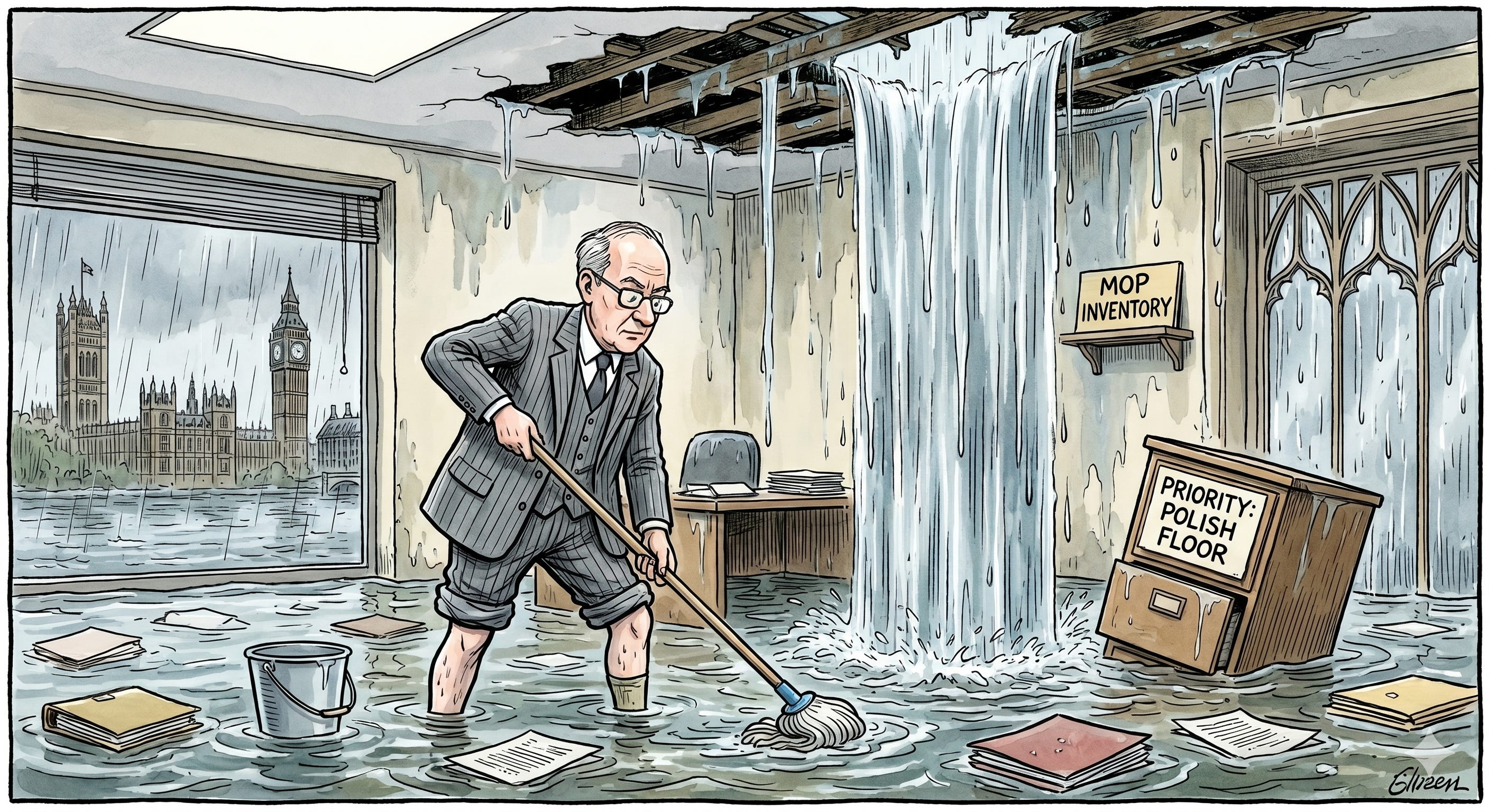
Ian Bauckham has a mop. What he needs is a roofer.

In March, Ian Bauckham, the head of Ofqual, the organisation which regulates exams in England, suggested that pupils have admitted to him that ‘that they use AI in their work but don’t tell their teachers’.
It wasn’t his own mesmeric powers of persuasion that raised my eyebrow; it was the idea that anyone, anywhere would be remotely surprised by that.
His framing was, essentially: students are cheating and the exam boards need to crack down harder. He gave them until the end of the month to explain how they were going to ‘strengthen’ their arrangements.
I can’t help feeling he was responding to a hole in the roof by polishing the floor. Maybe that’s the best you can do if you’re only equipped with a mop.
Bauckham has begun to evaluate the exam boards’ plans and it seems he has already begun to escalate his own response.
Last week, he suggested to Schools Week magazine that, of the courses of action open to him:
The most obvious one that people talk about is just simply getting rid of non-examined assessment. And it may be that in some cases that is the right thing to do.
There are other options and one possible solution discussed by Bauckham involves more teacher ‘checkpoints’ so they can be sure the work is ‘authentic’. It would also require more source referencing ‘so it’s clear you’ve not just asked ChatGPT to write 10,000 words for you‘. I can’t see it taking the average student more than 5 minutes to overcome that one.
He also referred to the development of better AI detection models. Mmm. I hope he speaks to the legal teams at Yale, Adelphi University and the University of Michigan before he goes too far down that line.
At least the floor will be gleaming. At best, these are administrative solutions to a pedagogical problem and they share a common assumption: that if we can verify the work is the student’s ‘own’, the assessment is doing its job. That assumption demands some scrutiny.
The coursework essay, completed over days or weeks outside of controlled conditions, has never been a clean lens through which to see how well a student understands a subject. It has long been smeared with the fingerprints of an over-eager parent, or sibling, or tutor, or friend on the bus who has ‘just helped a bit with the structuring’. Coursework is a proxy designed to mitigate the fact that some students are ill-equipped to give of their best in exam conditions and when a proxy becomes a target, it ceases to function properly as a proxy.
AI hasn’t created the problem of authentication. It has just made it harder to ignore. We used to manage it through a combination of hoping the teacher had sufficient familiarity with a student’s voice, a degree of institutional trust and a tacit agreement not to look too hard. As Ian Bauckham recognises, that’s not really an option any longer.
The hole in the roof is getting bigger and it’s starting to rain.
The more radical solution Ofqual seems to be considering does, at least, have some logic. If we cannot authenticate the work, we should stop pretending we can and getting rid of non-examined assessment does acknowledge that situation. Either everything would be assessed in exams or the ‘coursework’ element would be completed in supervised sessions, without internet access, in conditions where the teacher could be reasonably confident that whatever ended up on the page would be the student’s own work. So, basically, an exam.
Coursework was conceived as a way of assessing the skills that can’t be readily assessed in timed conditions: sustained research, the development of a complex argument over time, the synthesis of multiple sources. I’d suggest these are skills our students ought to develop; indeed, I’d say they are more important now than ever.
Scrapping coursework is not a neutral act. It would be an admission that we have given up assessing something very important, although one might suggest that had already been forced upon us by the ‘reforms’ Michael Gove introduced and we ought to be clear that we are only talking about the few elements that survived his cull.
Maybe it’s a price worth paying in order to preserve authentication - but we should be very clear that we would be paying a price.
The second option is to move in the opposite direction: accept AI’s presence and redesign assessment around it. Rather than trying to exclude AI from the process, we make the process itself the object of assessment. Students would work with AI transparently - drafting, questioning, evaluating, refining - and what is assessed is the quality of their thinking at each stage, not the polish of the final product. Did they interrogate the AI’s output critically? Did they bring their own knowledge and judgement to bear? Can they explain and defend the decisions they made?
This is closer to what skilled professionals actually do with AI, and it has genuine pedagogical merit. It also requires a wholesale rethinking of what we assess and how we do it
Both options require the same admission: that the current model is broken. Both require courage from regulators and exam boards that has not, so far, been much in evidence. And both are, in any meaningful sense, projects for the medium term to long term, requiring curriculum reform, consultation, and time that the teacher walking into a classroom tomorrow simply does not have.
What is he or she supposed to do, caught between an assessment system that hasn’t changed and a technology that has made its assumptions untenable?
I have been asked precisely that question a number of times recently. The simple answer is that I don’t have a solution that will either return us to a pre-AI world, as some would like, or fast-forward us to a point where we have been able to reconcile ourselves to the changes AI is precipitating.
I think we can make progress towards emphasising the process over the product, towards making thinking more visible in the classroom. Being transparent about our own use of AI and the use we would like our students to make of it would be another step in the right direction
It’s not a substitute for the systemic change the situation demands. It doesn’t resolve the assessment question and it doesn’t tell us how we can, with hand on heart, tick the box to verify that this is the student’s own work.
But it would give us better information about what our students actually know and it would start to create a culture where we genuinely value thinking.
For now, that will have to be enough. The rain is getting harder and I need to find a bucket.
Connect With Me
Beyond my writing and tutoring, I work directly with schools, educators, and organisations navigating AI integration. Take a look at my website and please get in touch - I’d love to hear what you’re working on.