
Active Intelligence: A Definition That Can Fail
The journey doesn't end in September. What to carry with you.

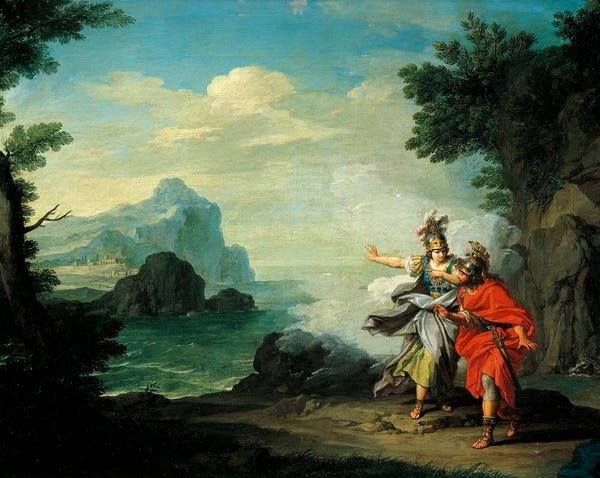
I began this series with the image of the Lotus-eaters from The Odyssey and the scouts, sent by Odysseus to recce the island, who were seduced by the sweet fruit. Tempted by the promise of endless leisure time, they forgot what they were supposed to be doing and just started lazing around on the beach. I suggested it is a powerful metaphor for the way many of us, and our students, interact with AI.
I also presented Odysseus as the man of action and vision, the one figure who could see the dangers and could plot the way forwards. He was the teacher we all want to be: intelligent, driven by purpose and leading his charges resolutely towards their ultimate destination - though dragging them by the hair and tying them to their benches is now firmly off the table. Times change.
Well, Odysseus is sometimes like that but he spends rather more of the epic confused, lost, hopeless and in tears. On Calypso’s island he:
...sat on the shore, and his eyes were never dry of tears, and his sweet life was ebbing away, as he longed for his return...
Sound more familiar?
The Odyssey is the surviving masterpiece of a whole tradition of Greek return-stories - nostoi and it gives us the word nostalgia. It was coined in the seventeenth century by a Swiss medical student, Johannes Hofer, who combined nostos (homecoming) and algos (pain or grief) to describe the grievous homesickness suffered by Swiss mercenaries fighting far from home.
Odysseus knew this feeling well and, from speaking to many teachers recently, either at conferences or via online platforms, I’d suggest that nostalgia is an overwhelming emotion for many who yearn for the days, before November 2022 and the launch of ChatGPT, when they could just set an essay and wait for the papers to be handed in (or not), content that they would give some indication of the students’ level of understanding.
For Odysseus and the Swiss mercenaries, it was a feeling associated with place. We now connect nostalgia with time, a journey to the past. Which, of course, is altogether less practical as a direction of travel.
The Ithaca Odysseus returned to was very different from the one he left and, similarly, the classrooms we return to in September will not look like the ones we were once used to. We often think of The Odyssey as the story of a journey, forgetting that he actually gets home about half way through (in Book 13 out of 24). And it is when he gets home that he finds some of his toughest challenges.
When he wakes on the shores of Ithaca, Athena has shrouded him in a protective mist, preventing him from acting rashly while still disoriented. When he’s ready, the goddess clears the mists and, over time, he develops absolute clarity about what is important to him and what he has to achieve.
Nostalgia offers us no such clarity. It only tells us what we have lost; it doesn’t tell us where to go next. From the conversations I’ve had with teachers this year, I don’t think the profession is unwilling to continue the journey forwards but I do think it lacks clarity about the next steps.
“Use AI well” is not a direction. Neither is “Keep the human in the loop”, nor “It’s just a tool”, nor any of the laminated wisdom currently migrating from conference slides to staffroom walls. Every one of these statements is true, which is precisely the problem. Statements nobody could disagree with are statements nobody has to act on. They are posters and we have seen with the growth mindset exactly what happens to an idea once it fits on one.
I’m very wary of adding another slogan to the wall. But, seven parts into this series, I feel I owe you a definition. I’ve written about inert and active use, about tasks a chatbot can’t complete from a standing start, about the difference between policy and practice and who gets left behind when we leave all this to chance. How can we bring everything together?
And, if it’s going to be a useful definition, it has to be one that can fail; it has to explain how we can fall short. And it has to tell us how to check if we are. Here is my attempt, resting on a warning Alfred North Whitehead issued a century ago:
Active Intelligence is what happens when a student brings their own thinking to an exchange with AI. Because ideas won’t keep - not theirs, and not the machine’s - something must be done about them.
It can fail in two ways. If the student brings nothing to the exchange, there is no Active Intelligence, however impressive the output. And if the student does nothing with what comes back - doesn’t test it, weigh it, accept or reject it for reasons they could tell you - there is no Active Intelligence either, only consumption.
And it gives us two questions we can ask of any task:
What did the student bring with them to the task?
What did they do with what came back?
If a task has no good answer to either question, then it isn’t the students who have failed it; it is the task itself.
In education, we talk a lot about destinations. That word implies a finishing line, an end point. Instead, we may have to accept that there is no settled post-AI world, no plateau we can reach by writing a policy. We must embrace perpetual becoming and accept the fact that the journey is ongoing.
Odysseus learns the same. On the very night of his reunion with Penelope, the suitors all dead, he tells her that the prophet has given him one more task. He must set out again, carrying an oar inland, until he reaches people so far from the sea that they mistake it for a winnowing fan. Homer never shows us that journey. The epic simply ends with it still to be made. The greatest homecoming in literature closes with the traveller about to leave again.
I find that oddly reassuring. It means the uncertainty we will feel about AI in September is not a sign that we have failed to arrive; it is what the work now permanently feels like.
The task in front of us is not to reach a settled destination but to keep asking those two questions of everything we set:
What did the student bring with them to the task?
What did they do with what came back?
We need to ask them of new tasks and of tasks that we have been setting for years.
Ideas won’t keep. Something must be done about them.
Connect With Me
Beyond my writing and tutoring, I work directly with schools, educators, and organisations navigating AI integration. Take a look at my website and please get in touch - I’d love to hear what you’re working on.
Really like the definition of active intelligence, Mark. Thanks!